
A University of Toronto research team has received US$2.3 million to build an open-access database and an AI model aimed at predicting which peptides bind to disease-relevant proteins. According to a university release carried by News-Medical on 14 October 2026, the project is called OpenPep. It is led by Joseph Brown, an assistant professor at the Leslie Dan Faculty of Pharmacy.
This is an early-stage research funding award. It is not a clinical trial or a regulatory decision, and no peptide drug is being tested or approved as part of it.
What was funded
The money comes through the Google.org Impact Challenge: AI for Science, according to the release. Google.org said on the same day that 17 organisations will share $36 million under the programme. The company added that recipients can join a six-month accelerator with engineering support and technical mentorship. The independent outlet Unite.AI reported that the call drew applications from 30 countries, spanning climate, health and foundational science.
The Toronto release says OpenPep will produce an open-access resource. Researchers could use it to apply AI to predict which peptides will bind to chosen target proteins.
The problem the team wants to address
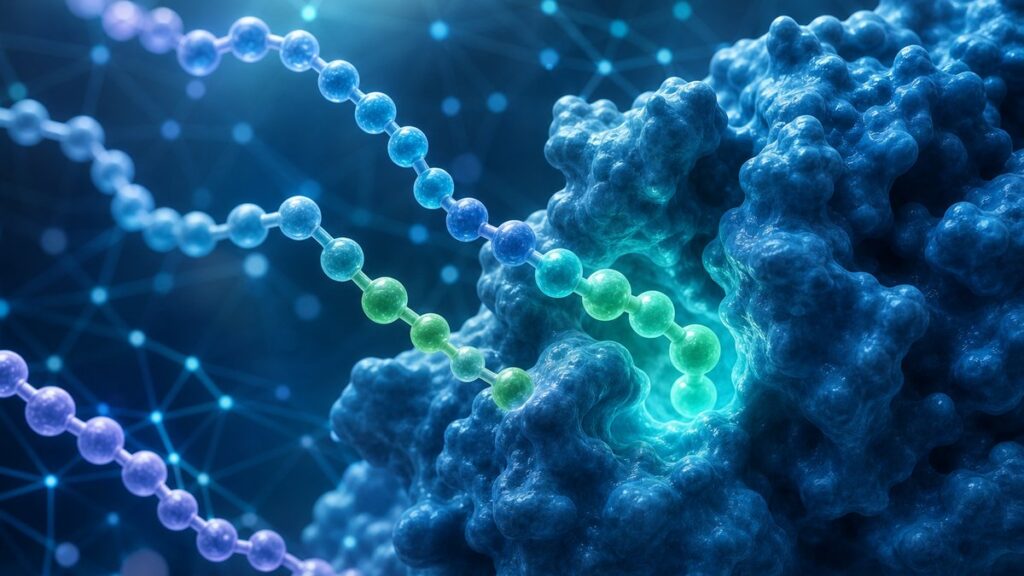
Peptides are short chains of amino acids. They are larger than conventional small-molecule drugs and smaller than proteins. The release says engineered peptides can be stable, precise and selective, which is why they attract drug developers.
The team argues that peptide discovery has relied almost entirely on laboratory experiments. It says the resulting data are scattered across labs, projects and companies, and that no comparable shared database and AI model exists for peptides. Brown is quoted as saying that the scarcity of data keeps peptide drug development slow, and that this motivated the group to gather large datasets and build chemically informed models. These are the team’s own characterisations. The news release does not offer independent evidence for them.
How the project is meant to work
The release describes a three-part plan:
- Producing targets. Keith Pardee’s group will use cell-free synthetic-biology systems to make up to 500 disease-relevant proteins, which the release describes as a snapshot of the human proteome.
- Generating binding data. Brown’s team will use specialised mass spectrometry to test large peptide libraries against those proteins. The aim is to measure which peptides bind and how strongly.
- Training the model. The experimental data will be used to build AI models that predict binding to proteins not yet tested in the lab. As predictions are tested and validated, the results will be fed back to refine the model.
The release also says the team will crowd-source suggestions for which disease-relevant proteins to target. The excerpt reviewed here did not include further detail on how that process will run.
The co-investigators named are Pardee, an associate professor at the same faculty, and Phil Kim, a professor at the university’s Donnelly Centre for Cellular and Biomolecular Research. The fourth is Chris Ing, co-founder and chief scientific officer of the Toronto company ProteinQure.
Background on the lead researcher
The university announced earlier that Brown would join the faculty on 1 January 2026. He was previously a staff scientist in the university’s Acceleration Consortium. The faculty describes his research as combining chemistry, biology and machine learning, with a focus on a technique called active learning. In active learning, each round of experiments generates data that improves the models and guides the next round.
What it means, and what is uncertain
If it works as described, OpenPep would give computational groups a shared, experimentally measured dataset for peptide-protein binding. Predicting binding is only one step in drug development. A peptide that binds a target well still has to show suitable stability, safety and activity in biological systems before it could be considered a drug candidate. The release does not say which diseases or targets will be prioritised, or which therapeutic uses the team expects to pursue first. It also gives no timeline for the database’s public release and no performance benchmarks for the model.
The project’s stated aims, including the claim that the resulting tool will speed discovery, are goals rather than results. No data have been published. Any future paper or database release would be the first opportunity to judge how well the models predict binding to untested proteins.
Sources
- News-Medical: New project receives $2.3 million to develop a database and AI model to identify therapeutic peptides (University of Toronto release)
- Google: 17 organizations awarded $36M for AI science projects
- Unite.AI: Seventeen Organizations Secure $36 Million From Google.org Challenge
- Leslie Dan Faculty of Pharmacy: New faculty Joseph Brown will explore how AI can accelerate peptide-based drug design
Source
This report is based on original reporting by News-Medical on 2026-10-14. Read the original article: New project receives $2.3 million to develop a database and AI model to identify therapeutic peptides.